Monday, October 14, 2013

Does It Get Any Easier, Part 2

When I was 29, John, my 19-year-old student was struggling with difficult personal decisions.

Problem 1
He realized that he was no longer in love with his high school girlfriend who was still living in his home town.

Problem 2
He had fallen in love with his best friend's girlfriend who was also in love with him.

I didn't know any of this when he preceded me up the stairs one day after class.  On the landing before opening the door to the fifth floor, he turned towards me and, near tears, said, "Does it get any easier?"

At the time I was struggling with my own dilemmas.  A few years earlier, I had put 3000 miles between myself and an ex, but relationships seemed to get worse and worse.  Now, my boyfriend of two years was becoming jealous and controlling.

I gave my student an off-hand reply.  We became friends though, and over the years, we did what we could to help one another with our problems.  Now we are both much older, so I thought I'd revisit the question.

So John, let me ask you, "Does it get any easier?"

Here's his reply:

I was talking about this with my teenage daughter yesterday, because she is going through a stressful week.
She said:  "I imagine that when I'm an adult I won't have all this worry and stress about school, but then I'll have bills to pay and I'll have to find a place to live so maybe it won't be easier."

 I said:  "You're right, things don't really get easier.  But, that being said, it seems to me that certain times of life in retrospect are very difficult.  In my experience, most people find teenage years very difficult, even if they have fond memories of that time.  Also, the first couple of years after the birth of a child are very difficult."
I wanted to be honest, but affirm her truth:  that she was going through a hard time and that she had a father that understood that.  I would add that moving or finding a new job are also difficult.  Moving, finding a job, and ducking rockets from Hezbollah all at the same time is even more difficult.  So you were right when you told my 19-year-old self that it gets weirder.  However, when we're young we're not so aware of the rhythm of life so everything seems like it will last forever and that makes those intense years difficult.  I'll quote from a magazine article I read:  "I can't say I know more than I did back then, but I have more experience not knowing it."
As a scientist, not as a father, the question makes less sense to me now than it did at 19.  To paraphrase Jaron Lanier (author of You Are Not a Gadget), there is either something weird about time or there is something weird about consciousness.  "Does it get" implies a linear passage of time that might not be scientifically correct, and "easier" implies a consciousness that is having qualitative experience and as scientists we know that we know almost nothing about self-aware consciousness.  Again, your original answer suffices.

 I'm sorry for answering so seriously, without a drop of humour.  As we know, gravity is the weakest force in the universe.
 There's probably a cosmic balance to the easier/harder question:
  1. Having patience gets easier.  Having energy gets harder.
  2. Cooking gets easier.  Matching calories to metabolism gets harder.
  3. Getting money gets easier.  Getting free time gets harder.  Or the reverse.  That's the deal.
  4. Getting laid gets easier.  Getting hard gets harder.
  5. Apologizing gets easier.  Screwing up gets easier, too.
------end of John's reply.

I imagine it's different for everyone.  Experience with difficulty usually helps.  The second time is still hard, but you know you can survive it.

What do you think?  Does it get any easier?

What Does Face-to-Face Mean?

It used to be that a face-to-face meeting meant that I could, potentially, touch your nose with my tongue.

You would "face" me and I would "face" you.  We would both be in the same place at the same time.  
Face to face means something else now, the same way "knowing someone" can mean many things.  
I can "know" someone I've never met face to face, perhaps even know that person better than people I've met face to face.
I was messaging with my internet friend, thenewgreen, aka Steven, and had this exchange:


Me:  I'm in Vancouver and might meet forwardslash.  Do you know forwardslash? 
Steven:  Do I know him? Of course I do.  He is formally on board team-Hubski!  You should absolutely meet up with him.  He is a very nice guy and his wife is really great too.
Me:  I mean "know" him in a face-to-face way?
Steven:  I've never met him face to face, but I talk with him every Monday night on our team calls via G+ chat, so it's kind of face to face.

If I was a brain in a jar, would it matter?
Would you know?  

Monday, October 7, 2013

What Should I Believe? (Part 4)

Subtitle:  Do You Believe in the Supernatural?

I tend to believe that the stars and planets have as much influence on my life as the entrails of goats.  Of course it's fun to imagine that our horoscopic sign, the year we were born, or our Myers-Briggs type can tell us something new and interesting about ourselves.

It's equally fun to do a Tarot reading for a friend.  Based on my knowledge of symbolism, I can suggest a path for my friend to follow, a path that one could say arises from the chosen cards.  In fact, my own desires for the other person's future and my intuition about their current life propel the interpretation as much as the pictures in the cards.  Both the Hanged Man and the Devil speak with one mouth:  mine.

In truth, I abandoned mysticism long ago.  My paranormal experiences continue to wait for a scientific explanation.  I can also live with the absence of explanation.  I don't need to understand everything.  Given the human brain's current capacity, there will always be mysteries.  Maybe the Global Brain can eventually solve them.

Even though I do not believe in horoscopes at all, my newspaper's horoscope column seemed to know that I was fond of questions.  Here's what it had to say about my birthday last August:
"If today is your birthday, the answers you get depend on the questions you choose to ask, so ask only those that are positive and uplifting over the coming year.  How can you change your life for the better?  How can you change the world for the better?  The answers will come."
The answers usually depend on the questions, birthday or not.  "How can I change my life for the better?" will lead your thoughts into a more productive place than "Why am I such a loser?"  The book Change Your Questions, Change Your Life, by Merilee Adams discusses how to use questions to improve our lives.  I don't know whether my birthday horoscope came from the stars or from the self-help shelf of a bookstore - maybe both.

Do you believe in invisible or supernatural forces?  Do you need to explain the unexplainable?

Monday, September 23, 2013

Should I Colour My Hair?

My mother was making an appointment for me with her hairdresser.  "He's really good," she said.  "He'll colour your hair."
"Why would I want to colour my hair?' I asked.
"You'll look 20 years younger?"
"Why would I want to look younger?  I'm not looking for a new boyfriend."
"You might," said my 86-year-old mother.

As I walked to the bus stop, I noticed several older cyclists smiling and nodding at me.  If I were looking for a boyfriend, it would be one of those grey-beards.

I like my grey hair.

When my mother was in her 40s, her hair turned grey almost overnight.  My father was dying and she had five children to raise.  After 10 years of widowhood, she married again.  This handsome, white-haired man insisted that she colour her hair and she was happy to comply.  "Grey looks distinguished on men," she said.  "On women, it just looks old."  My step-father passed on, but my mother continues the treatments.  "I'll stop dyeing my hair when I get wrinkles," she says.

I have friends who change their hair colour every month.  I'm probably missing out on opportunities for self-reinvention, but I have trouble sitting still even for a cut.

In 2005, I moved to Cabbagetown, a gentrified Toronto neighbourhood surrounded by lower-income housing developments.  Looking for a hairdresser, I wandered into one of the salons and asked how much for a wash and cut.  The receptionist said $40.
"Oh," I said, turning back towards the door.
"But you get an $80 haircut," said a customer at the counter, $40 in hand.

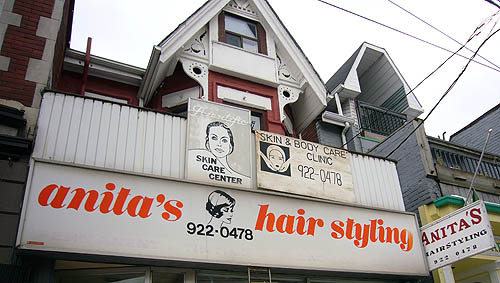
A block away was Anita's Hair Styling. Above the hair-styling sign was a sign saying, Scientific Skin Care Center and another next to it that said Skin and Body Clinic.  On the window it said, Anita's Unisex & Suntan Studio.  Anita's offered synthetic wigs, eyebrow tinting, ear piercing, massage, electrolysis, herbal remedies, facials, and more.  Anita was a Jill of all aesthetics.  Used clothes were on a rack out front.  Inside were piles of magazines and sale items.  Amidst the clutter, one could find a haircutting chair, an old-fashioned hair dryer, and a sink set up for washing.


I couldn't place Anita's accent, maybe Romany, 
and she might have been in her mid-to-late 70s. She was cutting the hair of an even more elderly customer.
"How much for a wash and cut?" I asked.
Anita looked me up and down.  She looked at my limp, long, unruly hair.  Even my split ends were split. "Twenty dollars," she said.
"But you get a $40 haircut," added the customer.

I went to Anita about once a year for the next several years.  Anita never suggested that I colour, tint, streak, or perm my hair into modernity. 

In late 2011, Anita's shop went dark. For a long time, the outside remained the same, but today I noticed that a cell phone company had painted Anita's storefront orange and moved in.

I have to face reality.  Anita is gone.  Next week I'll meet my mother's stylist.  When he suggests some colour, I'll ask him to make me more grey.

As for Anita, I'd like to think that she saved her pennies and has gone to cut hair somewhere warm.

Saturday, September 21, 2013

Should I Go to a Film Festival?

A film festival?  Yes, of course, absolutely -- if you like movies, if you are in a town with a film festival, if you can afford tickets, if you can get tickets, go!

What can a film festival, specifically the Toronto International Film Festival (TIFF) do for you that just going to the movies or watching netflix doesn't do?

You can travel around the world and see what stories are being told right now by very dedicated and determined film makers.  You can meet the directors, producers, and actors and ask them questions.  You can engage with a community of many other informed film goers in the endless lines.  You can be part of something bigger than your own desire for distraction.  You can be distracted!  But most of all, you might get a view into the zeitgeist of the times.

I should say, you get a view of your unique slice of the zeitgeist.  At TIFF, you choose from over 300 films representing 60 countries.  Everyone has a different experience and probably arrive at different conclusions about the zeitgeist.

Last year, for some reason, many of the films involved terrorists and dictators.  It was a dark time.

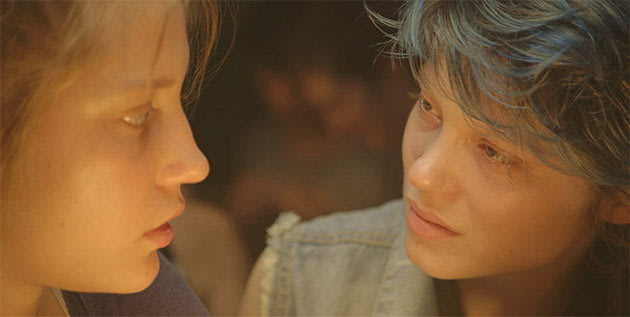
Globe and Mail writer, Johanna Schneller, found that her selection of movies dealt with the idea of freedom:  physical freedom, legal and social freedom, and freeing oneself from addiction or abuse.  We shared only one film, a very hot lesbian relationship story which she squeezed into her thesis by saying it was about the freedom to love who you choose.  I didn't see any issues of freedom in the movie Blue is the Warmest Colour.  The beautiful young women were not prevented from expressing their love.  The film left me with two messages:

1.  Ultimately, you are more likely to want someone who is intellectually, socially, and creatively compatible with you than the person who satisfies you the most sexually.  (However, we will  make sure the audience sees exactly how good the girl-on-girl sex is).

2.  If you really want to break up with someone, you can find a way to make it her fault.

What, then are the preoccupations of 2013?

My movies seem to suggest that change is inevitable and change is hard.  The process of giving up illusions, growing up, and adapting has to happen over and over again - even when you are 800-year-old vampires as in Only Lovers Left Alive.

In Fading Gigolo, Woody Allen's bookstore goes under.  To adapt to his changing economic situation, he enlists John Turturro, a gentle florist, to provide sexual services to rich older professional women.  They also help a woman re-enter the world of the living after her husband dies.  Through courage, creativity, and compassion, people endure financial and domestic changes.

The take-home message from Hateship Loveship seems to be that you can get what you want by really really wanting it.  People can change, and with persistence and a great deal of housecleaning, you can help them.

Club Sandwich, a Mexican movie, deals with a mother whose son is ready for some independence.  She has to change to allow this to happen.  The take-home message?  Do not play truth or dare with your kids.

In Mary Queen of Scots, a beautiful young Catholic woman, cousin to Queen Elizabeth, has to navigate among the treacheries of the Sottish Lords, a controlling Catholic husband, and the rising Protestant movement headed by John Knox.  Mary just wants everyone to get along. They don't.

One theme that persists through many of the films (and most storytelling) is that things are not what they appear to be.  People who seem to be against you actually love you.  People who seem to love you or should love you want to kill you.  Sometimes they kill you through their neglect and inattention as seems to be the case in Paul Haggis's Third Person.  It will take several viewings of that movie to figure it out.  Nothing is what it appears to be.


My film festival was not completely free of terrorism, torture, and totalitarianism.  Manuscripts Don't Burn, tells the story of an attempt by the Iranian government to murder 21 writers and journalists.  The director was present at the screening.  He told the audience, "Don't enjoy it.  It's unpleasant."  


There were no credits at the end of the movie for fear that the Iranian government would punish anyone involved with the project.

The film festivities are over and the Toronto is moving towards another large collective art event:  Nuit Blanche.  I have looked, but have never found a unifying theme in these all-night arts events except this:  people like to do things together in large numbers, to be part of a mob, to share, to communicate, and to seize the night.

Thursday, September 19, 2013

Do You Have a Best Friend that You've Never Met?


Do you?  Of course you do.  It's wonderful to be disembodied -- to be all mind, all wit, all language.

I first became aware of the best-friend-you've-never-met syndrome back in the late 1990s when ICQ became widely available.  One of my college students showed up to class as everyone was leaving.  She pleaded with me to understand that she lost track of time because she got into an urgent conversation with her BEST FRIEND EVER.

After further discussion, it emerged that because of the time difference, she rarely had a chance to chat with him.  He lived in Australia.  They had never met.

Exchanging thoughts, feelings, and ideas in letters, email, and instant-message web conversations is a powerful way to create intimacy.  Face-to-face meetings and rubbing up against one another also create intimacy, but embodied intimacy seems riskier.  Approval or judgement can be seen in the eyes or heard in the tone of voice.  Embodiment demands attention and presence which can distract us from being our most honest, authentic selves.

My mother and father met at a wedding in 1946, but they fell deeply in love through the daily letters they exchanged.  My father was in NYC and Washington in various veteran's hospitals and my mother was in university in Toronto.  Without their correspondence, my mother would have ended up with one of her other suitors, and I would not be writing this now.

I had two best friends that I had never met.  We exchanged ideas and collaborated on projects including podcasts and writing.  They also helped me by linking discussion on their website to this blog.  Recently, I met my two best disembodied friends. How adorable they are.

The only problem was getting over the border to the Mercury Bar, a block away.

Border Guard:  "You are coming to Detroit to meet some people you've never met?"
Me:  "Well, yeah, but they're our best friends."
Border Guard:  "And you're meeting in the Mercury Bar?"
Me:  "Right."
Border Guard:  "Then you're going back to Canada?"
Me:  "Exactly."
Border Guard:  "Let me get this straight:  you drove four hours from Toronto to spend four hours in a bar with people you've never met?  Then you are going to turn around and drive four hours back to Toronto?"

At this point, Cadell Last, who was in the passenger seat, reached across me waving his iPhone at the border guard, and said, "Here's the meetup invitation.  Look."

Did meeting my new best friends in person make a difference?  Not to me.  Their embodied selves were indistinguishable from their disembodied selves, although perhaps a little drunker.

What about you?  Do you have a best friend that you've never met?  What's it like?

Tuesday, August 13, 2013

Unfinished Business? When Is It Finished?

"I feel I have some unfinished business with you," I said upon re-meeting a one-time love interest.
"I hope we always have unfinished business," he replied.
That could be a good way to look at the unfinished business issue.  
(Although with relationships, it might be best to cut your tethers and set off down the forest path towards your next adventure.)
Distance, timing, urgent priorities, and the endless complications of sustaining a creative, independent life can lead to much unfinished business:  apologies unsaid, affection unaffirmed, debts unpaid, courses and degrees pending, library books unreturned.  Every six months or so, I push notes, scraps, ideas, and projects off my desk into a laundry basket: unfinished business.
But my thoughts today are on unfinished business with the dead:  the knot of sadness buried in our being never to be untied.
Sometimes, we untie it.

In December 1968, my father, Sid Blum, was dying of cancer.  Except for one trip we took together when I was 10, we weren't normally very close.  He was a busy man, totally engaged with fighting for human rights and social justice in everything he did.  I was more likely to feel his anger, than to feel his love.  I so wanted his praise or approval, but had little direct experience of it.
School was out for winter vacation and I was sent to NYC to visit relatives.  My mother spent her time rushing from work, to home, to the hospital.  The other four siblings were banging about, doing what they do.  My older sister was in university, studying sociology, following father's footsteps.  My older brother was playing in a band, and the two younger brothers were little boys.  For some reason, I was the lucky one -- or maybe I was seen as the troubled, moody one.
The trip was transformative.  I stayed with my father's first cousins -- the ones who knew him best, who grew up with him.  They gave me directions from Brooklyn to Manhattan and let me explore.  They took me to the old neighbourhoods and told stories.  I began to understand my father's childhood:  who he had been, and where he wandered before the war.

I couldn't wait to tell my father about all my discoveries, about my new understanding; but by the time I returned, he had fallen into a coma and did not revive.  He died in the early hours of the new year.  He was 42.  And I was left with my revelations unshared.

I finished another year of high school and went to university in a province far away. Ten years passed, and once again I was living in my mother's house, in my old room.  By then, I was in graduate school studying literature.  My father had loved literature and floor-to-ceiling bookshelves filled the house.  His books were still there and many were useful in my graduate courses.  It was fall, and every day I walked through the red and golden forest to the university.
One Monday night, I dreamed my father visited me and wanted to talk.  I woke up thrilled and unsteady, and rushed to class where I was lost in a wistful lightness.  He returned the next night, and the next -- every night that week.  We talked and talked.  I finally told him about my trip to New York, my understanding of his childhood, the news from his relatives, my studies, my worries.

It took ten years, but I finished my unfinished business with the dead.  The knot was untied in my subconscious.

What about you?  Have you any unfinished business with the living or the dead?