Showing posts with label Family. Show all posts

Tuesday, October 29, 2013

Were You Planned? Did It Matter?


Your parents will tell you what you want to hear or tell you what they've convinced themselves to believe.  They might even be reliable witnesses to their own lives and tell you the truth.  By the time you ask, "Was I planned?" they might have even forgotten.

"When I found out you were coming," my mother told me, "I was so happy.  Three children seemed to me to be a real family."  Happy is good, but I can't remember if that's the same as being planned.

Being happy to have me is probably much more important than intending to have me.  I can't say being planned or unplanned mattered one way or the other.  Everyone adjusted.

There are five of us in my family.  I think it went like this:  unplanned, planned, unplanned, planned, unplanned.

These days, except in religious communities, it might be hard to find a family with more than three children (per parent).  The 2011 fertility rate in Canada was 1.61 children per woman; 1.89 in the USA.  Many will likely be planned.  In fact, a US study found that between 1982 and 2010, 63% of babies were intentionally conceived.

My husband was planned.

Roosevelt signing the declaration of war against Germany
Almost 75 years ago, on Krystallnacht (November 9), his father, Kurt Baecker was arrested and sent to Dachau.  At that time, the Nazis hadn't yet conceived of the Final Solution, and would deport Jews if they could find a country willing to take them.  Kurt's family managed to find a very distant relative in the USA who was willing to sign an affadavit of support.  Once in America, Kurt and Alice, his wife, desperately tried to get Alice's parents out of Vienna.

December 7, 1941
Japan bombs Pearl Harbour
Kurt and Alice realize that the US will now enter the war, and it will be impossible to get any family members out of Europe.  They decide that night to start their own family.

My husband was born Oct. 7, 1942, exactly 10 months after the bombing of Pearl Harbour.


Thursday, February 21, 2013

Do I Need a Near-Death Experience to Become Bold and Grateful?

You don't need a near-death experience to become grateful, but it helps.  If the first one doesn't take, you might need two.  

In September, 2008, the spousal unit, Ron, ate some bad cheese at a resort in Quebec and developed a near-fatal case of listeria-meningitis.  Luckily, he was saved by massive amounts of antibiotics.  The doctors told me that if I had taken him to the hospital the night before, they probably would have sent him home.  If I had waited any longer, it would have been too late.

Ron was in the hospital for 10 days and came home wearing a portable antibiotic infusion pump for another 10 days.  For that period and the two weeks following, he was intensely conscious of his surroundings and grateful for his survival.  Every outing into the neighbourhood was wondrous:  colours were vivid and sparkling and people, plants, animals were all miracles of creation.

Then the wonder and gratefulness fell away with the autumn leaves and the winter of stress and anxiety returned.
Meanwhile, a post-recovery brain scan revealed a benign meningioma.  By March 2012, the meningioma had to be removed.  Ron seemed to recover quickly from the surgery, but two months later he had a setback and his condition became increasingly worse.  By September, he could barely function.  MRI evidence suggests his temporal lobe, left amygdala, and hypothalamus might have been "tickled" during the delicate surgery.  This might have affected his sleep, mood, memory, and motivation.

In December 2012, Ron began to recover.  This was accompanied by a new boldness and gratefulness, and it seems to be sticking.

Today we cycled out at 6:30 a.m. to watch the sunrise.  Ron adopted the persona of an Italian in the Tour de France and greets everyone with "Buongiorno."

"Buongiorno," he said to a lithe, long-haired jogger.  She smiled and said "good-day" back.
"I wish I had known this when I was 20," he said.
"Known how to be bold?" I asked.
"Yes, and grateful.  I was definitely not grateful when I was 20."

Do you need a near-death experience (or two) to remember to be grateful?

Monday, January 28, 2013

Chess: Real Time or Internet Time?

We were chatting with an older British man yesterday about activities available on this island.  He said that he enjoyed chess and ping pong.
"Chess," the spousal unit said.  "I'd enjoy a chess game."
"I only play online," he replied.  "In fact," he continued, "I'm in the middle of three games right now.  I'm playing people in Spain, the Ukraine, and Maine."  (He did resemble Henry Higgins.)  "I find face-to-face chess too slow."
Face-to-face might be slow, but computer chess is even slower.  You make your moves over several days or weeks, but you don't have to twiddle your thumbs waiting for your opponent to move.  You are playing outside of actual time.

In real time, face-to-face chess may be slow, but it has the wonderful advantage of providing human company, developing a friendship, frustrating or exhausting your opponent and yourself, and forcing you to think on the spot.  Should you  conquer your opponents, they can shake your real hand.  You can sometimes even take back a move if the other player is feeling generous.  My family had various strategies to deal with slow players.  My grandfather would call his moves from his bed where he would nap during a slow game.  Uncle George (A"H) memorized all the soliloquies of Hamlet one summer while waiting for his opponent to move.

Internet chess has the advantage of not leaving you stuck in front of a chess board.  You are sent a message when your opponent makes a move.  You can pick up your message and rejoin the game, anywhere, anytime.

Long distance chess has always been popular.  Before the internet, chess was played by postcard, one move at a time.  After my father died, I found 100s of chess postcards among his papers -- 3" X 5" cards with three-cent stamps printed on them.  He must have bought and used these between 1947 when he moved to Canada and 1954 when the rate went up to four cents.  These games kept him in touch with a close friend or relative - maybe a fellow patient at the veteran's hospital where he stayed during and after World War II.

My father never spoke of his long distance chess matches and they produced no stories.  Meanwhile, the face-to-face chess that my family played produced many stories: stories of anger, embarrassment, sabotage, and deceit.  My story on four generations of chess can be found here.

Which would you rather play - internet chess or face-to-face?


Monday, January 14, 2013

Is Your Family Like Any Other?

     When my daughter was 22, in her last year of university, she spent a lot of time with her boyfriend's family.  She was surprised to discover that his family had meals together, "They all sat down at a table and had conversations.  Nobody read - or watched TV."

     "Was it fun?" I asked.
     "It was difficult."
     "Did it get easier?"
     "Sometimes, sometimes not."

     Ouch.  This was news to me.  During her years at elementary school, it was mostly just the two of us at mealtime.  She had a child's picnic table in the living room where she played with her imaginary friends, read books, ate meals, and watched TV.  Of course we had many meals with friends and extended family members, but she was always most comfortable sitting at her picnic table eating Cheerios.  When she grew out of the table, I gave it away to friends who had a toddler.  She's still kind of mad about that.

     We grow used to our family's ways of doing things.  As children, we visit other neighbours or our parents take us to their friends' homes and it can be like visiting a foreign land.  I recall peering through locked glass doors in my cousin's house and seeing elegant living room furniture covered in plastic.  How could this be?

     A visitor to my childhood home said with astonishment,  "You're allowed in every room in your house?"  Even if my parents wanted to keep a room child-free, they couldn't.  There were eight of us:  five children, two parents, and my grandmother -- more of us than rooms in the house.

     It can take a while to shake the belief that one's family is the norm.  My family always had two salt shakers on the table.  I didn't realize till I was in my 20s that, in most families, the other salt shaker was for pepper, a spice too exotic for us.

     Were you ever surprised by the practices of other families?

Monday, December 31, 2012

What Does the New Year Mean to You?

I wake up slowly, first realizing that I'm in my own bed.  I feel my husband's warm body next to me.  My next awakening thoughts are that my daughter and mother are safe and alive.  My brothers and sister and their children are all alive.
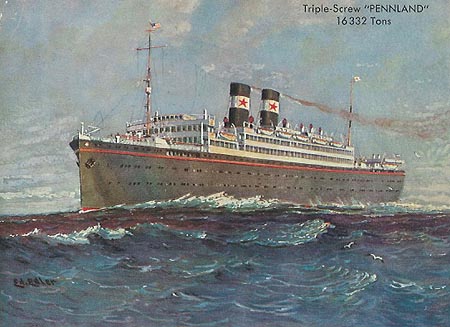
I recall that it's the last day of the year, and I am in a country where freedom is possible.  I'm suddenly grateful to my grandmother for getting her family out of Europe travelling on the Pennland (shown here) from Antwerp arriving in Halifax on June 13, 1926.  Fifteen years later, her family and neighbours would be herded into ghettos, trains, camps, and ovens.

It's hard to appreciate my freedom without thinking that, in whatever time is left for me, with my own small words and deeds, I have to move in the direction of peace and freedom for all.

From my winter window, I see the barren trees reaching into the grey sky -- nests in the high branches, now visible.  I wonder whether the builders of those nests will return home, to the same tree, in spring.  Like the birds, I've learned to create new homes when necessary.

January 1, New Year's Day, is my mother's birthday.  She will be 86.  January 1 is also the day my father died in 1969 at 43 of causes related to his trauma and injury in the war.  My early morning thoughts again take me back to the war, back to Europe.  The man who will become my father attempts to capture an enemy pillbox and steps on a landmine which blows off his foot.

January 1 is always a day of remembering death and celebrating birth - in my family's story and in the year itself.

I'm in Canada now, so I get out of bed and wander to the local Tim Horton's to write these thoughts.  My Tim's, at the corner of Parliament and Winchester in downtown Toronto, is always full of people and conversation, so I connect with humanity, but I am never disturbed by the conversations.  People speak in all the languages of Africa, Asia, and eastern Europe.  They inspire without distracting.  Welcome to Canada.  Welcome to the new year.

As Jack Layton said at the end of his last letter to Canada:  "Love is better than anger, hope is better than fear, optimism is better than despair.  So let us be loving, hopeful, and optimistic, and we'll change the world."  Starting with ourselves, of course.  Happy new year.

Wednesday, July 25, 2012

Are You a Good Son (Mother, Father, Partner, etc. etc.)?

A friend of mine (male, early 30s) is living a mountain range away from his mother.  His father died a couple of years ago and his mom (late 50s) has been trying to get on with her life.  He said he wants to be a good son.  I asked him, "What do you think being a 'good son' means?"

He didn't know.  He hadn't thought of it in terms of a set of criteria.

We want to be "good" partners, friends, and family members even when there are difficulties with the other person.  If we are in a relationship, we generally want to do our part to make it good.  It might be useful to have specific behavioural goals instead of assuming goodness.  People who need to protect themselves from difficult parents might still want to be a "good" son or daughter.  Guilt and a sense of duty might push them towards family, but fear, ambivalence, or resentment pulls them away.

If there's closeness, respect, and acceptance, we want to be around family and do all we can together.  Some people, however, need to put up boundaries of protection and be free to create themselves.  In these cases it might be helpful to define for yourself what it might mean to be a good whatever.  Set minimum actions (e.g. phone once a week).  As the relationship changes, eventually your actions will be fearless and spontaneous and flow from open-hearted love.

When my daughter was young, I decided that being a good mother included giving her swimming lessons.  A lot of "what is a good mother" had to be figured out.  It's not instinctive.  It might be the same with all our roles.

Self-Definition Goals


Some goals are long-term goals that we set out to achieve step-by-step:  complete a degree, find a job, run in a marathon, and so on.


Other goals involve ways of being:  being a good employee, partner, or parent.  If my goal is to be a "good" daughter to an elderly parent, or a "good" partner in a relationship, what does that mean specifically?  We could ask the other person and consider their answer, but their definition of "good" might be different from our own.

Can you define your roles, at least partly, in terms of specific realistic behaviours?  What is one of your most important self-definition roles (student, sister, brother, daughter, son, lover, team member, parent, etc.).  Pick one and think of some specific behaviours:


I would consider myself a good ________________________, if I


1. ___________________________________________________________

2. ___________________________________________________________
3. ___________________________________________________________

You can then measure your level of achievement against your own criteria -- not someone else's.  You don't have to feel inadequate or guilty all the time, and you can fortify yourself against other people's accusations of inadequacy.

Friday, April 6, 2012

How Do You Observe Passover?

At the Passover seder, we meet to celebrate the freeing of the Jews from slavery to the Egyptians.  We read, discuss, sing, and perform rituals as set out in the Haggadah, a book assembled by The Rabbis between 170 and 300 CE.

Near the beginning of the seder, we find the passage beginning Ha Lachma.  We point to a plate of matzah and read:

This is the bread of affliction that our forefathers ate in the land of Egypt.  All who are hungry, let them come and eat.  All who are needy, let them come and celebrate the Passover with us.  Now we are slaves; next year may we be free.  Now we are here; next year may we be in the land of Israel.

For many years, we focussed on the line, “Now we are slaves; next year may we be free.”  Each person would discuss the way he or she is still a slave, or whether they are more free this year than last.

At one point, we switched from slavery to “Now we are here; next year may we be in the land of Israel.”  Each person would consider what it means to be here now.  We asked, "Where or what is your promised land?"

At Passover, we must get rid of chametz, which is bread and other foods containing yeast.  The chametz can also symbolize anything in our personality that is puffed up or arrogant.  One year we asked,  “What is the chametz in your life?  How can you get rid of it?"  The next year we asked, "Have you got rid of last year's chametz?"  Year after year our conversations deepen as we become closer to one another.

This year, I mentioned to my mother that it might be interesting to consider "All who are hungry, let them come and eat."  I was thinking about our willingness or unwillingness to be charitable, but my mother said, "Yes!  Let's ask, 'What are you hungry for?'"

There is much to be hungry for.  Some of the guests will say, "Food!  Let's eat now!"  (We tend to go on for hours before the festive meal is served.)  Others will think about the oceans of complaints and restless longings for love, connection, and understanding.  We may talk about our hunger, but a little later we sing "Dayanu" which serves as a reminder to appreciate what we have.

I might retreat to my original interest in discussing charity.  I found this quote from 19th century rabbi, Yisrael Salanter.  He said,  "We must prioritize spiritual matters over our material desires, but other people’s material needs are our spiritual concerns."

Passover is also a time for me to remember to stop thinking about other people's flaws and develop more compassion and resourcefulness.

          "In depth of winter I finally learned that there was in me an invincible summer."  - Albert Camus

Tuesday, December 6, 2011

Are Stories Necessary?

The stories that move us, touch us, and change us are necessary.  It may not even be character, plot, or setting that makes a story necessary, but the telling of it, the shape of the narrative, the voice of the teller, the way an idea or feeling from a story starts to dwell in the reader inspiring more ideas and feelings.

Stories give shape and detail to memory.  And, when we lose our memories, we still need stories, maybe more than ever.

In the early stages of her dementia, my mother-in-law became obsessed with her watch.  When we visited, she'd hold her watch up and peer at it from different angles.  Then she'd shake it, insist it was broken, and ask the time.  I'd tell her the time.  She'd be quiet for 30 seconds and then begin to look at her watch again and fret over it and demand to know the time.

"What time is it?  It's broken?  Do you see the time?

 1:15.  1:18.  1:20...

My husband and her caregiver were frustrated and impatient.  They wanted to distract her, to take the watch away, to do something else, but it only agitated her more, so we sat.

1:22.  1:23.  1:26.

"What time is it?  It's broken?  Do you see the time?

1:31

"Oh," she said.  "Now's the hard part."

"What do you mean?"

"It has to climb up the other side."

As her life became increasingly reduced - she still needed stories.  She saw in the youth of the hour, the early minutes, the big hand skipped easily down the right side of the watch face.  Life was good.  But then came the climb up through the 6, 7, and 8 of the hour, as if they were the later decades of life, the hard part.  I understood her story - an ancient one.  The wheel of fortune turns. 

Stories are necessary.

Friday, September 2, 2011

What Is Our Deal?

I teach a workshop called Communicating Nondefensively.  During the workshop, participants identify a statement that made them feel defensive.  It's a corporate workshop, so people usually use examples from their bosses, clients, or co-workers; but they might also quote their friends or parents.  At a recent workshop, one young woman said that this statement from her mother makes her feel defensive.

"When are you going to get a real job?"

She was doing an unpaid internship with a nonprofit company.  I asked her if she had a "deal" with her mother - an agreement in which her mother supports her during this phase of her career.  She said she did.  I asked her whether the deal had been articulated.  Were they both subscribing to the same deal?  She wasn't sure.

My aunt told me this:  "Every relationship is a deal.  The problem is you don't always know what the deal is.  I was once in the hospital getting surgery and my husband told me he had to fly to South America for his work.  That's when I understood our deal."

Thursday, September 1, 2011

What Did You Sign Up For?

One of my best friends Liam, is in a long-term relationship with his lover Paul.  Twenty-five years ago, Liam moved in with Paul's family which included Paul's wife and daughter Sarah, who was 13 at the time.  Ten year's later, Sarah developed MS with progressively worsening symptoms.  The whole family cares for her and for one another in their home.  As various family members travel for work, Liam might be home alone for a week providing personal care to their daughter as required.

Someone said to Liam sympathetically, "This isn't what you signed up for."
He replied, "I choose my family very carefully.  There are no givens.  When you sign up, you take what comes your way."

What will you sign up for?
What will keep you from signing off?

Wednesday, August 3, 2011

What Can Parents Learn from a GPS Navigation Unit?

You've typed a destination into your GPS and it has decided on a route for you.
For reasons unknown to the unit, you decide to deviate from its route.
It says, "Recalculating" and then tries to convince you to go back to the original route a few times.  It will ask you to turn right, then turn right, or to make a U-turn.  Eventually it realizes what's happening and accepts the new route.

Recalculating involves giving up its version of reality and dealing with the facts on the ground.  There are many routes and you are taking a different one.
*******
"Mom, I decided that I don't want to be a doctor.  I want to be a musician.  I can make a few dollars as a school crossing guard -- that'll give me time to compose music during the day.  I'll practice with the band at night."
"Recalculating.  Maybe you can take biology at night school."
"The band will be practicing every night."
"Recalculating.  If you apply to med school in the fall, you might be able to get in next year."
"We'll be on tour."
"Recalculating.  .... Recalculating.... When can I hear you play?"

Tuesday, August 2, 2011

Why Don't Our Children Learn From Our Mistakes?

First of all, they do learn from many of our mistakes - especially if we have learned from those mistakes by the time the children arrive.  They also make many of the same mistakes we make.  It's genetic.  Mistakes are also hormonal.  Since, sometimes our precious and beloved children are the result of our mistakes, it's counter-intuitive for them not to make the same ones.

Sunday, July 31, 2011

What Risks Did You Take Today?

     I grew up in an activist family.  My parents were engaged in human rights and social justice issues.  In the evening, when we'd get together for dinner, my father would turn to me and my siblings and ask us this question:  What did you do today for the benefit of humanity?  I didn't understand the meaning of "benefit of humanity," but if I answered, "I helped the teacher erase the chalkboards," I'd get a nod and a smile.
     Many years later, I began to wonder how my life would have been different if my father had asked us, "What risks did you take today?"
     I mentioned this to my older brother, and he said, "That was the question."
     I said, "Um, no.  The question was about benefiting humanity."
     He said, "Those were the words, but the real question was, What risks did you take today?  How did you challenge authority today?  How did you stick it to the man today?"
     I phoned my older sister in B.C. and said, "Remember when we were kids and Dad asked us what we did for the benefit of humanity.  What was he asking?"
     Without hesitation, she said, "What he meant was how did you help your mother today."
     I emailed my younger brother.  He said that he heard this:  How did you help to free the slaves and achieve justice on the planet?